
First A String

  In November of 1847, a civil engineer named Charles Ellet Jr. was commissioned to build a bridge across the Niagara Gorge. As you can imagine the greatest challenge was the start. How could you get the first cable across an 825-foot chasm with 225-foot cliffs on either side?
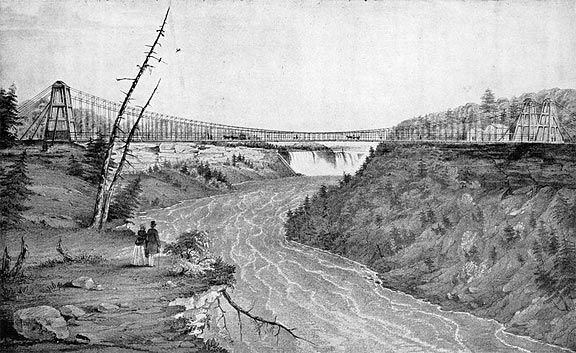

  The solution came from a local ironworker named Theodore Graves Hulett, who suggested a kite-flying contest. A fifteen-year-old boy named Homan Walsh won the ten-dollar cash prize for flying the first kite across the chasm.

  The day after that successful flight, a stronger line was attached to that kite string and pulled across. Then an even stronger line. Then a rope. Then a cable consisting of thirty-six strands of ten-gauge wire. The bridge would eventually become the world’s first railway suspension bridge. It would connect two countries, and it was strong enough to support a 170-ton locomotive. And it all started with a single kite string!

"For who has despised the day of small things?” Zechariah 4:10

  Some tasks seem at the start to be insurmountable. We can’t see how something so large can be overcome. But never underestimate the value of small things.  A small action can lead to more. Too many times we do nothing, thinking a small act is meaningless. Yet action begets action, one step takes you to the next, and success leads to more of the same.

 Is there something you are struggling to overcome? Some task that seems too big to overcome? A relationship broken by too big a gulf? A habit that overwhelms you? Start with a small attempt. Even the smallest action can lead to something bigger.

It may not be much more than a string but it could build a bridge.

Comments

Popular posts from this blog

I Know All Those Words, But That Sentence Makes No Sense To Me

  Let’s say you travel back in time six hundred years or so.  Luckily, you happen across a fellow that speaks English.  Upon hearing your tale, he describes you as nice, smart, and handsome.  Wouldn’t you feel good?   You shouldn’t.  As Sol Steinmetz in his book, Semantics Antics , explains; Nice originally meant someone who was foolish, ignorant, senseless, or absurd (middle English 1300). Smart for the first 300 years of its use meant causing pain, sharp, cutting, or severe, a sense that survives in the idiom "smart as a whip.” Handsome wasn’t complimentary. When coined around 1425, it just meant easily handled; it didn’t have its current positive connotation until 1590.   You might think he said you were a kind, intelligent, good looking bloke, when in reality he said you were a foolish pain easily dealt with.   Words have an annoying habit of changing meaning over time in the same language and it becomes even more compli...

Master Your Self

  In a contest for the toughest president of the United States, it would be hard to go against Theodore Roosevelt.  He was known for his “manly” pursuits hunting big game, climbing the Matterhorn, participating in boxing match while president. (These weren’t play fights, he lost the vision on one eye because of them!)  Once before he was about to give a speech an assassin shot him in the chest.  Roosevelt refused to go to a hospital and insisted on giving his speech, still wearing his blood-soaked shirt!   Teddy might have become tough but he wasn’t born that way.  He was a sickly child that suffered from severe asthma that almost proved fatal.  As was a young boy, doctors discovered that he had a weak heart, and advised him to get a desk job and not strain himself.  He was homeschooled because of his many illnesses and spent most of his time indoors.   But then as a teen his father, whom Teddy Roosevelt revered, told his son, “ ...

The Gift You Give Yourself

    I always hated buying gifts for my Mom. If I got her something like a new set of pans, it was like saying “Here’s something you can use to go make me something to eat”. A gift for her was seemingly a gift for me.   There are however gifts you give that benefit you more than the receiver. For example, forgiveness. When you give it, you are giving it to yourself as much as you are giving it to them. Jesus said that when we forgive others it means God is forgiving us our wrongs (Matthew 6:14-15).  I once read: “ Heaven is where everyone's forgiven. Hell is where nobody's forgiven.  So, when we forgive we pull heaven down into our lives.  When we withhold forgiveness, we pull hell up into our lives ” Give yourself something nice today, Forgive.