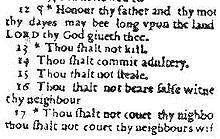
 There are collections of bible translations
know as Bible Errta that are a much sought after find for book collectors. They are Bibles that were made famous because
of a print error or mistranslation that caused a humorous or unique mistake. When these errors were discovered the printers
were force to destroy most copies making them a rarity. Such examples included the Wicked Bible of
1631 that left out the “not” in the 7th commandment and the “Printers Bible” of
1612: in which some copies of Psalm 119:161 reads “Printers have persecuted me without a cause” rather than “Princes have persecuted me…” Another
famous one is the “Sin on Bible" of 1716 where John 8:11 reads "Go and sin on more" rather than
"Go and sin no more".
There are collections of bible translations
know as Bible Errta that are a much sought after find for book collectors. They are Bibles that were made famous because
of a print error or mistranslation that caused a humorous or unique mistake. When these errors were discovered the printers
were force to destroy most copies making them a rarity. Such examples included the Wicked Bible of
1631 that left out the “not” in the 7th commandment and the “Printers Bible” of
1612: in which some copies of Psalm 119:161 reads “Printers have persecuted me without a cause” rather than “Princes have persecuted me…” Another
famous one is the “Sin on Bible" of 1716 where John 8:11 reads "Go and sin on more" rather than
"Go and sin no more".
I was reminded of this mistake when I was
recently teaching in John 8 and the women caught in adultery. Even though the text is correct in all other
versions, some still try to make that print error fit in the text.
You may remember the story. In an effort to trap Jesus, the scribes and
Pharisee bring to him a woman caught in the act of adultery. The law of Moses says adulterers are to be
stoned, but what will Jesus say? The
trap is to either force him to break the Law of Moses or to make him look like
he is hypocritical in his teaching about saving sinners. Jesus doesn’t fall into the trap, rather he
writes in the dirt. Then he makes a very
pointed statement:
"He who is without sin among you, let him be the first to throw a stone
at her."
One by one, oldest to the youngest the
accusers disappear leaving no one left to accuse her. Jesus then tells her, "I do not condemn you, either. Go. From now
on sin no more."
Some look at this story and try to use it to
show that Jesus isn’t worried about sin.
Jesus didn’t condemn her, so how can we condemn someone in sin. You can continue
to live in sin and God will forgive you.
Once you have been saved it doesn’t matter if you continue to sin, his
grace will cover you. You can “go and sin on more”
That however isn’t what Jesus said or what the
Bible teaches. Jesus doesn’t need to judge
our sin, we already stand judged (John 3:17). He came
to save us from sin not to save so we can sin. As Romans 6:1-2 tells us, “What shall we say then? Are we to continue
in sin so that grace may increase? May it never be! How shall we who died to
sin still live in it? His command to
her is the same for us “Sin No More”.
We should never mistake the grace of God as
tolerance of sin (Romans 3:5-8). His
mercy should never be turned in a license to sin (Jude 4). To do so would put us in a worst state than
we started in (2nd Peter 2:20-22). Sin corrupts and traps (2nd Peter
2:19). The faithful must end sinful actions (Galatians 5:24).
We can’t “go and sin more”. Sin comes at too high a cost (Hebrew
10:26-29). Others may not condemn us for our sin but God will in his
righteousness will, if we don’t turn away from it.
Comments
Post a Comment