Playing to Win or Not Lose?

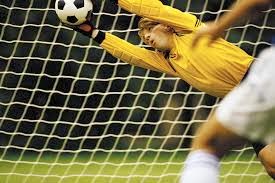
   What would you cause more pressure, a shot to win or a shot to not lose? A great example of this is when soccer players take penalty kicks to settle a tie.  The odds of making a penalty kick are at 85%, for professional soccer players. So there is a high expectation that the kick should be made.   

   Imagine taking the last penalty shot for a professional team.  Which situation would you prefer?
1-Your team is down by one, and you have to make it to tie; if you miss, your team will lose.
2-Your team is tied, and you do not have to make it, but if you do make it, you will win.
   
 According to the research of Geir Jordet and Ester Hartman, when missing the kick will cause the kicker’s team to lose, professional kickers make on those shots only 62% of the time. But when making the goal will result in a win, they find the net 92% of the time.  It is the same kick, the same twelve yards every time, but there is a 30% gap in the success rate. The difference between the two kicks is the first is labeled as a threat (to not lose) and the second is labeled as a challenge (to win).  The psychology behind the kick is huge.*

   
 Let’s apply this lesson to our spiritual lives. Is our mind set to not lose or to gain? Our regret of the mistake or the chance of our success?  What should our attitude be? In Philippians 3:13-14 we read, “Brethren, I do not regard myself as having laid hold of it yet; but one thing I do: forgetting what lies behind and reaching forward to what lies ahead, I press on toward the goal for the prize of the upward call of God in Christ Jesus”. Paul want us not to focus on our mistakes but keep looking forward to what lies ahead. This is an attitude that is more likely to bring success. In Christ, the victory is already won! Instead of adopting the negative mindset fearing loss, let’s have one that knows we win if we keep moving upward! 

*Credit Matthew Modine "Musing On Spiritual Matters" for illustration 


Comments

Popular posts from this blog

I Know All Those Words, But That Sentence Makes No Sense To Me

  Let’s say you travel back in time six hundred years or so.  Luckily, you happen across a fellow that speaks English.  Upon hearing your tale, he describes you as nice, smart, and handsome.  Wouldn’t you feel good?   You shouldn’t.  As Sol Steinmetz in his book, Semantics Antics , explains; Nice originally meant someone who was foolish, ignorant, senseless, or absurd (middle English 1300). Smart for the first 300 years of its use meant causing pain, sharp, cutting, or severe, a sense that survives in the idiom "smart as a whip.” Handsome wasn’t complimentary. When coined around 1425, it just meant easily handled; it didn’t have its current positive connotation until 1590.   You might think he said you were a kind, intelligent, good looking bloke, when in reality he said you were a foolish pain easily dealt with.   Words have an annoying habit of changing meaning over time in the same language and it becomes even more compli...

Master Your Self

  In a contest for the toughest president of the United States, it would be hard to go against Theodore Roosevelt.  He was known for his “manly” pursuits hunting big game, climbing the Matterhorn, participating in boxing match while president. (These weren’t play fights, he lost the vision on one eye because of them!)  Once before he was about to give a speech an assassin shot him in the chest.  Roosevelt refused to go to a hospital and insisted on giving his speech, still wearing his blood-soaked shirt!   Teddy might have become tough but he wasn’t born that way.  He was a sickly child that suffered from severe asthma that almost proved fatal.  As was a young boy, doctors discovered that he had a weak heart, and advised him to get a desk job and not strain himself.  He was homeschooled because of his many illnesses and spent most of his time indoors.   But then as a teen his father, whom Teddy Roosevelt revered, told his son, “ ...

Until Midnight

    In Acts 20, there is the tragicomic event surrounding a young man by the name of Eutychus. He did what a lot of folks before and after him did, he fell asleep during a sermon. Unfortunately, he was setting in in the third story window at the time. So instead of nodding off and hitting the pew in front of him, he fell to his death. The good news was the apostle Paul was delivering the sermon and had the ability to bring him back.       I don’t know, however, if we can judge Eutychus too harshly. The sermon had gone on till midnight. Paul wouldn’t finish it up till daybreak. That’s a long lesson. I know some folks that might want to jump out of a window if I had a lesson that long, yet these Christians wanted to be there to hear Paul.   Don’t get me wrong, I’m not pushing for all night sermons but I think we might need to adopt these folks' dedication. They knew that Paul was only in town for a limited time only and they were determined to ...